Showing posts with label Socrative. Show all posts

Monday, 30 May 2016

Session 7

Hello again digital teachers,

I’m Amaranta and today I will explain to you the things that we learnt during Session 7 with Maribel. The last session was about Ipads, the new trendy thing in relation with education nowadays. The amount of applications and resources that Ipad offers us is amazingly growing. Currently, either teachers and students can access to and endless ways of learning and teaching by using ICT in the classroom. However, how can teachers and students chose the right application that they want to use?

Choose the right one!

In this session, Maribel showed us a useful tool where different applications are organized by the skills that students are developing or by what the teacher want them to focus on such as photo editing, recording, interactive writing, creating a game...etc. If you are looking for an specific app this website might be useful for you!

Here you have some other websites (examples, reviews..) where applications are well organized and will save you a lot of time when looking for the good one! Hope you find them all worth it.


In addition, if you feel that it is too difficult to assess Ipad work, here you will find some resources to do it such as rubrics and grids that will make it easier and faster: Ipads4TEACHING

Quizz response games

Related with the assessment, during the session we also learnt different apps or programs that you can use it as a way of assessment or if you prefer as a quizz response games that children need to answer faster. In this way, children use technology in a more motivating way that help them to review the content while using Ipads, computers, smartphones...Personally, I will absolutely recommend all teachers Kahoot and Nearpod. If you want to know more about Kahoot you can read my last post and you will find further information. As for the Nearpod, I have discovered recently and I’m amazed about all the possible things it can offers. Nearpod allows you to work in groups, write with a purpose, express your knowledge by drawing, develop your critical thinking...etc. In short, take part in a quizz where all the learning styles are taken into account.


The rest of the class we focused on StoryTelling. However, we didn't spend time reading books but we learnt lots of websites to create our own story! In this sense, children are the authors of their literacy creations and develop the four skills in a contextualized way. You can ask them to create whatever they want after exploring all the resources or let them read for a while. Here you will find good apps to do it! Want to know more about them? Scan this QR code:


Price and Platforms
Skills
Purpose
Shadow Puppets
Free/ Ipod, Iphone, Ipad...
Communication
Collaboration
Creativity
Create and design
Creating high-quality, versatile presentations is really easy. Students can use their own images or pull images from several impressive online resources

Puppet Pals
Free/ Ipod, Iphone, Ipad...
Communication
Collaboration
Creativity
Kids can learn how each part of the creative process works to form a story as they make decisions about which backgrounds and characters to use in each scene, how to size them and move them around, and which audio to record.

Toontastic
Free/ Ipod, Iphone, Ipad...
Communication
Collaboration
Creativity
A fantastic digital storytelling tool that empowers kids to organize ideas, transforming them into entertaining animated cartoons


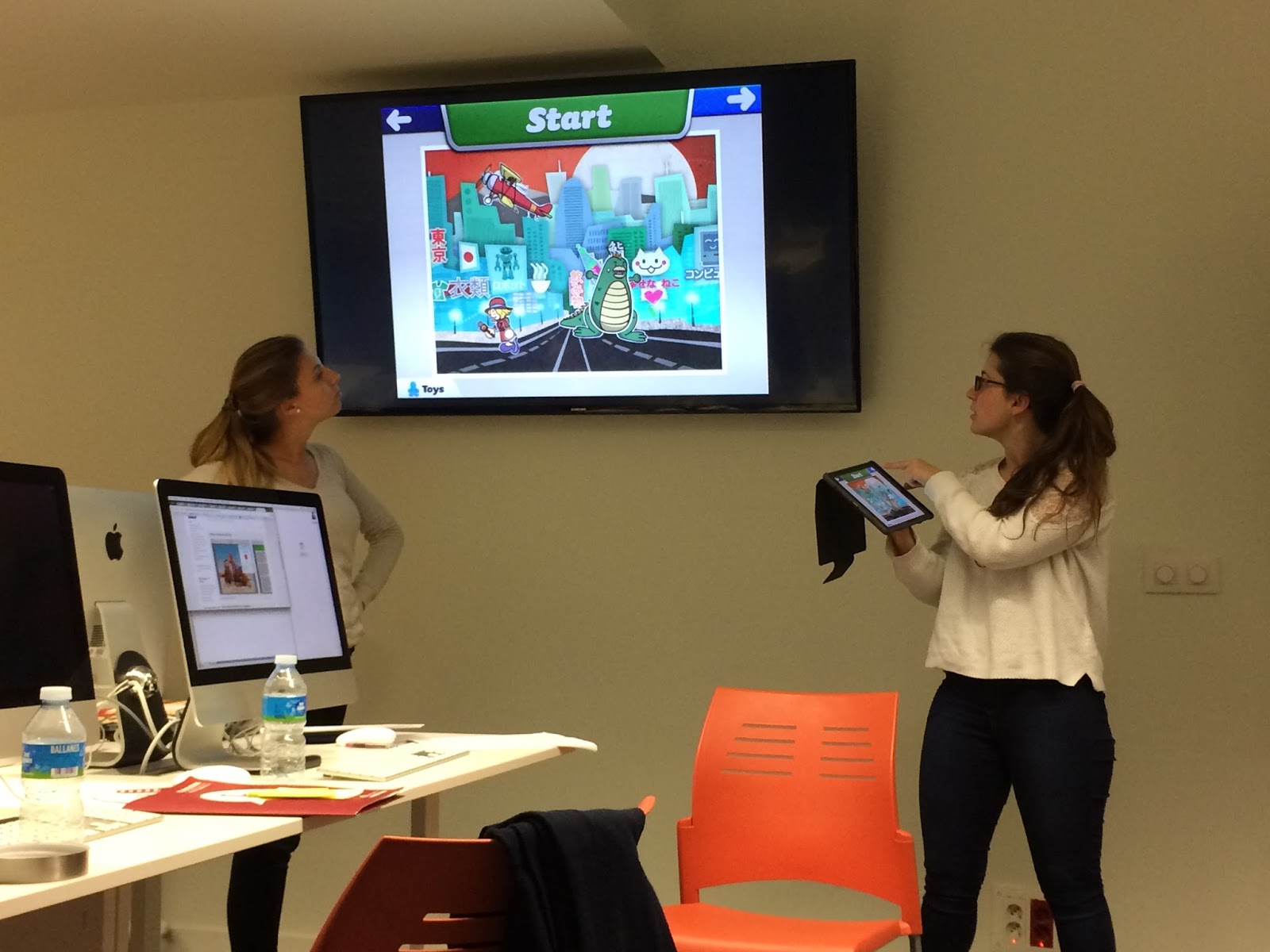
Some photos of our projects and presentations:


Tuesday, 24 May 2016

The ant and the grasshopper with iPads

Hello everyone,

We are Míriam Porras, Ma Àngels Tugores and Anna Solé. We are going to present a lesson plan related to the story “The ant and the grasshopper”. We strongly believe that it is useful to use a source as iPads to carry out the following activities, because they can enjoy the storytelling time in a different way.

We hope you enjoy the following lesson plan and it would be useful in your classrooms! 

We would start the lesson with the following app to introduce the story “The ant and the grasshopper”:


The pupils could interact during they are listening or reading the story. For instance, they could help the ant to pick food or to help the grasshopper when she is frozen because of winter.

After reading or listening the story, they would complete different activities like making a puzzle or replying different questions or pinpoint objects observing images from the story by the app. Then, we would ask them several questions concerning the story to know if they understand and comprehend the plot. Finally, we will divide the class in different groups and we will create an alternative ending for the story.


Target audience

The activity created is to be developed with 1st Grade. It depends on the level of your class-group and the knowledge they have in the additional language (English).

Aims: 

- To develop the oral skills: listening and speaking. (Students)
- To acquire vocabulary related to story. (Students)
- To be able to understand a story told it in English. (Students)
- To develop their iPad skills (Students)

Vocabulary related:

    Ant, grasshopper, summer, winter, woods, foods, snacks, candy, snow, clothing, door, scar, house, moon.
    Help, remove, give, play
* Alternative and spontaneous vocabulary that suits the topic.

Competences:

    Linguistic and audio-visual, because pupils have to watch, read (in some cases) and to understand different vocabulary in relation to the story.

    Management of information and digital, to complete the activity the students have to use and interact with the IWB to carry out the activities).

    Knowledge and interaction with the world, using stories we can develop the imaginary of our pupils and also we can connect the relationship that animals have in the story with the human relationship and feelings like help or friendship.
    Social and civic, we are going to divide the class in different associations promoting the cooperative group and the individual
    Learning to learn (The students will have to think about what ingredients they would like to add to the pancake and so they will have to create it and present it to the rest of the classmates. Thus they will have to manage their time effectively and regulate their own learning whilst solving problems).

Class management

In relation to classroom management, each pupil would have an iPad to follow and interact with the story and then, to do the proposed activities like puzzle or the evaluation part. However, at the end of the lesson plan, we would divide the class in different groups with the aim to create an alternative end to the story and present it using story creator.
The main aim is to promote the communication among students using the additional language (English) and the IWB as a tool to reach it.
*If any school that would like to carry out this lesson plan and they don’t have available iPads for each students, we could divide them in more groups to do the previous activities before the creation of the story ending.


Bloom’s Revised Taxonomy

The lesson plan offers the possibility to improve lower and higher order thinking skills:

Lower order thinking skills
    Level I – Remembering the vocabulary and the story they have learned.
    Level II – Understanding the vocabulary and the concepts that the story and the activities present, not only remember them.
    Level III: Applying and practice the vocabulary they have learned in different ways and activities like puzzle, assessment or create a story.

Higher order thinking skills
    Level VI: Creating their own version of the end of the story and then, they will have the opportunity to share it to their peers.

Four skills

The lesson plan we have created, it takes into account the four skills that are the following:

RECEPTIVE
PRODUCTIVE
Listening:
The pupils will listen the story, the explanations of their teacher and their classmates when they are preparing the alternative ending and presenting it.


Reading:
The pupils could read the story and the instructions to interact with the ant. Also, they need to read the activities of the IWB.
Speaking:
They will have to speak with their peers to create the alternative ending and to cooperate to present it in front of the class. Also, we have to promote the interaction with the teacher using some words in English.

Writing:
They will have to create and write the alternative ending for the story of “The ant and the grasshopper”.


Activities with iPads

The lesson plan is divided in the following activities:

Activity 1: The ant and the grasshopper
In this activity, the pupils will know the story reading it or listening it by the teacher. Meanwhile, we could interact with the ant doing some actions like helping the ant to carry candies or give to grasshopper the scarf for the winter.


Activity 2: TinyTap
In this activity, the pupils could interact with different activities concerning the story like making a puzzle of one of the images from the app or recognise vocabulary like scarf, moon, candy, house, etc.  Finally, they could watch another video version of the story to develop their listening skills.
Puzzle


Video

*If you pick on the objects of the image, you will listen how do you say this word and what is the written word

Activity 3: Socrates
To assess if they understand the story, we have created a Socrates with different kind of questions regarding the literacy elements. Here you would find some examples:


Activity 4: Create an alternative ending
The pupils will be divided in different groups and create an alternative ending for the sort of “The ant and the grasshopper” using Storyjumper (https://www.storyjumper.com/main/help). The teacher will help these groups with difficulties in English and problems to use the program to collect their stories. At the end, they will have to present it to the rest of the class.

Assessment

In relation to assessment, it would be carried out through observation during the activities and the Socrative we have created to assess if they understand the plot of the story. In addition, we will take into account the oral presentation of the alternative ending to assess the lesson plan and the cooperative work through rubrics.


Try it in your classroom and send us recommendations to improve the lesson plan!!